The Agentic AI Governance Problem: Why Enterprises Are Deploying Before They Are Ready
Suvajit Sengupta | 27th June, 2026
12 min reads

Suvajit Sengupta | 27th June, 2026 | 12 min reads
The Problem Nobody Is Saying Out Loud
Something consequential is happening inside enterprise technology right now — and it is not yet showing up in board risk registers, CISO quarterly reports, or regulatory examinations.
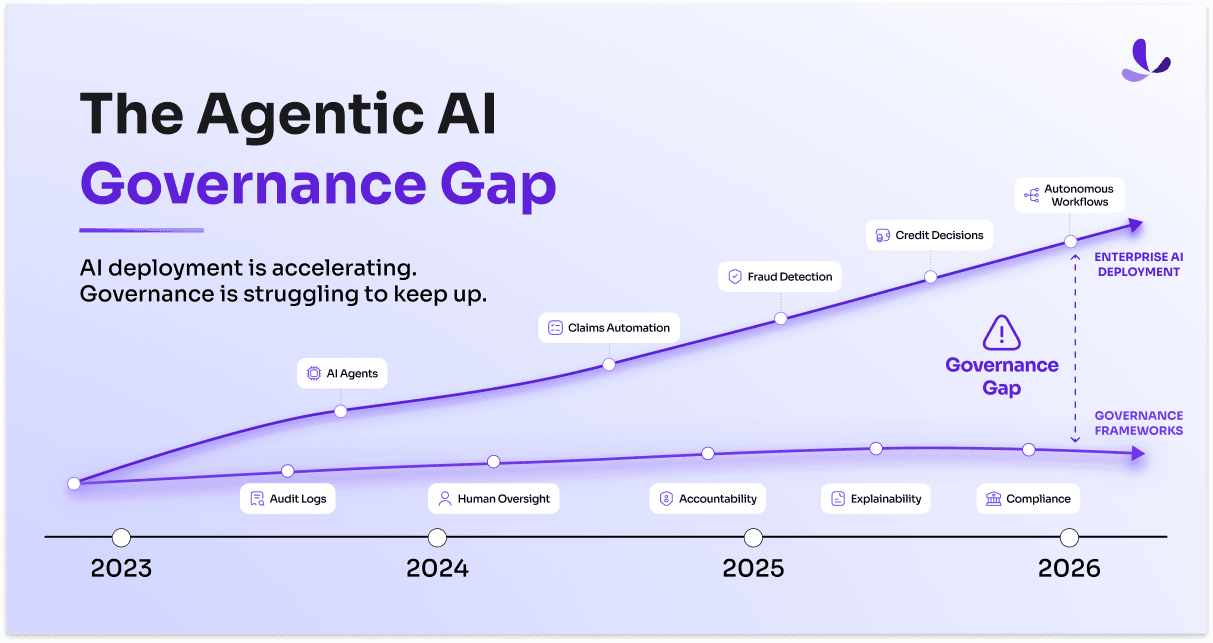
Organizations across banking, insurance, healthcare, and enterprise technology are deploying agentic AI — AI systems that do not just generate outputs but take autonomous actions — at a pace that is substantially outrunning their ability to govern what those systems actually do.
Agentic AI schedules, decides, approves, flags, escalates, and initiates. It operates inside workflows that influence real outcomes for real customers. And in most enterprises deploying it today, there is no audit trail for its decisions, no accountability chain for its actions, and no governance framework that adequately defines what it is permitted to do and what should trigger human review.
This is the agentic AI governance problem — and it is more material than the current enterprise conversation suggests.
What Agentic AI Actually Means for Enterprise Operations
The term 'Agentic AI' has become common enough that its implications are beginning to blur. It is worth being precise about what it actually means in an enterprise context.
Traditional Enterprise AI — the kind most organizations spent 2020 to 2023 deploying — generates outputs that humans then act on. A fraud score. A document summary. A risk classification. A customer segmentation. The AI produces information; the human decides what to do with it.
Agentic AI is different in a structurally important way. It acts. Given a goal or a set of instructions, an agentic system plans a sequence of actions, executes them using available tools, monitors results, adjusts behaviour, and continues operating until the goal is complete — often without a human in the loop at each step.
In practice, this looks like an AI agent that independently processes incoming insurance claims, routes them, requests additional documentation from policyholders, applies fraud detection logic, makes preliminary approval or rejection decisions, and escalates only the cases that fall outside its configured confidence thresholds. Or a credit operations agent that monitors a portfolio, identifies covenant breaches, initiates remediation workflows, and communicates with counterparties — all autonomously.
The capability is significant. The efficiency gains are real. The deployment momentum is substantial.
The governance infrastructure, in most enterprises, is not there yet.
The Governance Gap: What Is Missing and Why It Matters
When we examine enterprise agentic AI deployments, the governance gaps tend to cluster around four consistent problem areas.
Audit Trail Absence
Most agentic AI systems in production today do not maintain granular, queryable audit logs of their decision processes. They record inputs and outputs — but not the reasoning chain between them, the alternative paths considered, the confidence levels applied, or the data sources weighted most heavily. When a decision is challenged, the organization cannot reconstruct how it was reached.
Accountability Chain Ambiguity
Who is accountable when an agentic AI makes a consequential error? The vendor who built the model? The team that configured the agent's instructions? The business owner who approved the deployment? The answer is almost never documented clearly in advance — which means the answer gets determined reactively, often in a regulatory or legal context where no one wants to be first to claim ownership.
Instruction Documentation Gaps
What an agentic AI system is instructed to do — its goals, constraints, escalation thresholds, and behavioural guardrails — should be documented with the same rigor as any other production policy. In practice, instructions to AI agents are often stored in informal configuration files, are not version-controlled with change management processes, and are not reviewed by risk or compliance functions before deployment or update.
Human Oversight Protocol Absence
The question of when a human must be in the loop — and with what authority and information — is fundamental to safe agentic AI deployment. Most enterprises have not formalized this. High-stakes decisions made by agentic systems often reach customers before any human has reviewed them, not because this was a deliberate policy decision, but because the governance conversation was never had.
The Regulatory Picture Is Clarifying — Faster Than Most Organizations Are Preparing
Regulatory frameworks for AI are not converging on a single global standard. They are arriving from multiple directions simultaneously, and the common thread across all of them is accountability infrastructure.
The EU AI Act, which entered full enforcement in 2025, requires organizations deploying high-risk AI systems — a category that includes AI used in credit decisions, insurance underwriting, employment, and essential services — to maintain logging of system inputs and outputs sufficient for post-deployment monitoring, human oversight, and regulatory examination.
India's DPDP framework and the RBI's AI governance circular for regulated financial institutions align on the same principle: if an AI system influences a decision that affects a customer or counterparty, the institution must be able to explain that decision. Not in general terms. Specifically.
ISO 42001 — the AI management system standard that is increasingly becoming a procurement requirement in enterprise contracts — requires documented AI governance processes, including risk assessment procedures, human oversight protocols, and audit log management.
Agentic AI deployments that cannot meet these baseline expectations are not just governance risks. They are compliance exposures that will become material as regulatory examination intensity increases through 2026 and 2027.
Industry Context: Where the Gap Is Most Acute
Banking and Financial Services
Agentic AI in credit operations, fraud detection, and customer service is being deployed at scale across major banking institutions. The RBI's expectations around explainability and human oversight are explicit — but implementation timelines inside institutions are lagging the deployment pace. The gap between what is running in production and what the governance framework covers is widening quarterly.
Insurance
Claims processing agents, underwriting automation, and fraud investigation workflows are the primary agentic AI deployment areas in insurance. IRDAI's evolving position on AI-driven decisions in claims — informed by consumer complaints and regulatory supervision — will create compliance pressure points for institutions that have not built adequate audit infrastructure.
Healthcare
Clinical decision support, patient triage, and administrative automation are deploying agentic AI in healthcare contexts. The accountability stakes here are qualitatively different — decisions influence patient outcomes — but the governance infrastructure is often no more mature than in financial services.
What Governance-Ready Agentic AI Deployment Actually Looks Like
The goal is not to slow down agentic AI deployment. The goal is to ensure the governance infrastructure exists to support it. The following are the practical building blocks that distinguish governed from ungoverned agentic AI in enterprise environments.
Comprehensive Decision Logging
Every consequential action taken by an agentic AI system should be logged with sufficient granularity to reconstruct the decision path. This includes the inputs received, the reasoning steps applied, the tools invoked, the confidence thresholds crossed, and the outputs produced. Logs should be queryable, tamper-evident, and retained in line with regulatory requirements.
Instruction Documentation and Version Control
The goals, constraints, behavioural guardrails, and escalation thresholds configured for an agentic AI system should be treated as formal policy documents — reviewed by risk and compliance functions, version-controlled, and updated through a change management process that is as rigorous as any other production policy change.
Human-in-the-Loop Protocol Design
Before deployment, high-stakes decision categories — claims above a certain value threshold, credit decisions above a certain limit, any action that initiates customer-facing communication — should be mapped to explicit human review requirements. This is not about slowing the system down. It is about ensuring that the governance design is intentional rather than accidental.
Accountability Assignment
Document clearly: who is accountable for the agentic AI system's decisions. Which business owner approved the deployment. Which technical team maintains the configuration. Which risk function performs ongoing monitoring. Who has the authority to modify system behavior. Who has the authority to pause or halt the system. These assignments should be in writing, updated when they change, and known to everyone on the accountability chain.
Behavioral Monitoring Beyond Performance Metrics
Enterprise monitoring infrastructure is typically instrumented to catch system failures — downtime, latency, error rates. Agentic AI also requires monitoring for behavioural drift: are the system's decisions changing over time in ways that correlate with different outcomes for different customer segments? Is the system's confidence calibration holding? Are escalation thresholds being triggered at the expected rates? These are governance signals, not just performance metrics.
Actionable Takeaways for Enterprise Leadership
Conduct an immediate inventory of all agentic AI systems currently running in production, including those deployed by third-party vendors operating inside your workflows.
Assess each deployment against the governance building blocks above — audit logging, instruction documentation, human-in-the-loop protocols, accountability assignment, and behavioural monitoring.
Treat the governance gap as a risk register item, not a technical debt item. The distinction matters for how urgently it gets resourced.
Begin the regulatory readiness assessment now. EU AI Act, DPDP, and RBI AI governance expectations are not aspirational — they are current requirements.
Include agentic AI governance as a standing agenda item in board risk committee meetings. Not as a technology update, but as a governance accountability discussion.
The Window for Proactive Governance Is Still Open
The agentic AI governance problem is not insurmountable. It is solvable, and the organizations that solve it proactively will have a meaningful structural advantage over those that address it reactively under regulatory pressure.
The capability curve of agentic AI will continue to steepen. The regulatory curve of AI governance expectations will do the same. The organizations that keep those two curves in proximity — deploying capability with commensurate governance — will be the ones operating sustainably at scale in 2027 and beyond.
The governance window is open. It will not stay open indefinitely.
KRIYAM.AI — CALL TO ACTION
Kriyam's fraud intelligence platform is built on the principle that AI-driven decisions in BFSI must be auditable, explainable, and accountable — from the first deployment. If your organization is deploying or planning to deploy AI in fraud detection, underwriting, or claims processing, we would like to show you what governed, integrated fraud intelligence infrastructure looks like in practice. Speak with our team.
FREQUENTLY ASKED QUESTIONS
What is agentic AI and how is it different from traditional AI?
Traditional enterprise AI generates outputs — predictions, classifications, recommendations — that humans then act on. Agentic AI acts autonomously: it plans, executes, monitors, and adjusts actions to achieve a goal, often without a human at each decision point. The distinction is important because it changes the risk profile and the governance requirements significantly.
Why do existing AI governance frameworks not cover agentic AI adequately?
Most enterprise AI governance frameworks were designed for decision-support AI — systems that inform human choices. Agentic AI replaces human choices in many contexts, which requires governance infrastructure designed for autonomous action: decision logging, instruction documentation, accountability chains, human-in-the-loop protocols, and behavioral monitoring. These requirements are structurally different.
Which regulatory frameworks currently address agentic AI?
The EU AI Act addresses high-risk AI systems with requirements that apply to agentic deployments in regulated contexts. India's DPDP and RBI AI governance circular address explainability and human oversight expectations. ISO 42001 provides a management system framework applicable to agentic AI. None of them are specifically written for agentic AI — but all of them apply to consequential autonomous AI decisions.
How should enterprises prioritize the governance gap?
Prioritize by consequence. Begin with agentic AI deployments that influence customer-facing outcomes, financial decisions, or regulated activities. These carry the highest regulatory and reputational exposure. Build governance infrastructure for these deployments first, then extend the framework across other deployments.
What role does Kriyam play in agentic AI governance for BFSI?
Kriyam's fraud intelligence platform provides the audit infrastructure, behavioural signal monitoring, and explainable decision architecture that BFSI institutions need to deploy AI-driven fraud detection and investigation workflows with confidence — and with the auditability required by Indian and international regulatory frameworks.
About the author
Suvajit Sengupta
Co-founder & CTO
Suvajit Sengupta | Co-founder & CTO
A passionate technologist who thrives at the intersection of customer needs and innovation. With a track record of building adaptive product teams, he share insights on solving real-world problems with AI and scalable tech solutions.
Interests: AI products, Team Leadership, Data Strategy
Content Overview
Share
FEATURED
Insurance
5 Ways Agentic AI is Transforming Insurance Industry
This blog explores how pioneering insurers are leveraging Agentic AI to solve critical challenges—from eliminating claims backlogs to hyper-personalizing policies—while addressing ethical and operational hurdles.

Sreyan M Chowdhury
30th March, 2025