logo
logo
AI Document Processing
Research
Try NowGet a Demo
Document Processing

Inside DocWise: How Documents Turn into Context-Aware Intelligence

Suvajit Sengupta | 22nd October, 2025

5 min reads

Suvajit Sengupta

Suvajit Sengupta | 22nd October, 2025 | 5 min reads

cover

When we started building DocWise, our goal wasn’t just to extract text from documents.
We wanted to help systems understand them, the way a person would.

Documents are not just collections of words. They carry meaning through structure, relationships, and context. A header tells you what a section is about. A table groups related information. A signature at the bottom validates intent.

Humans read all that instantly. Traditional systems don’t.

The Problem with Traditional Document Processing

For years, document automation relied on OCR and templates. They work, until something changes. A small layout shift, a new font, or a missing field can make the entire pipeline fail.

OCR can tell you what the text says. It can’t tell you what the text means.

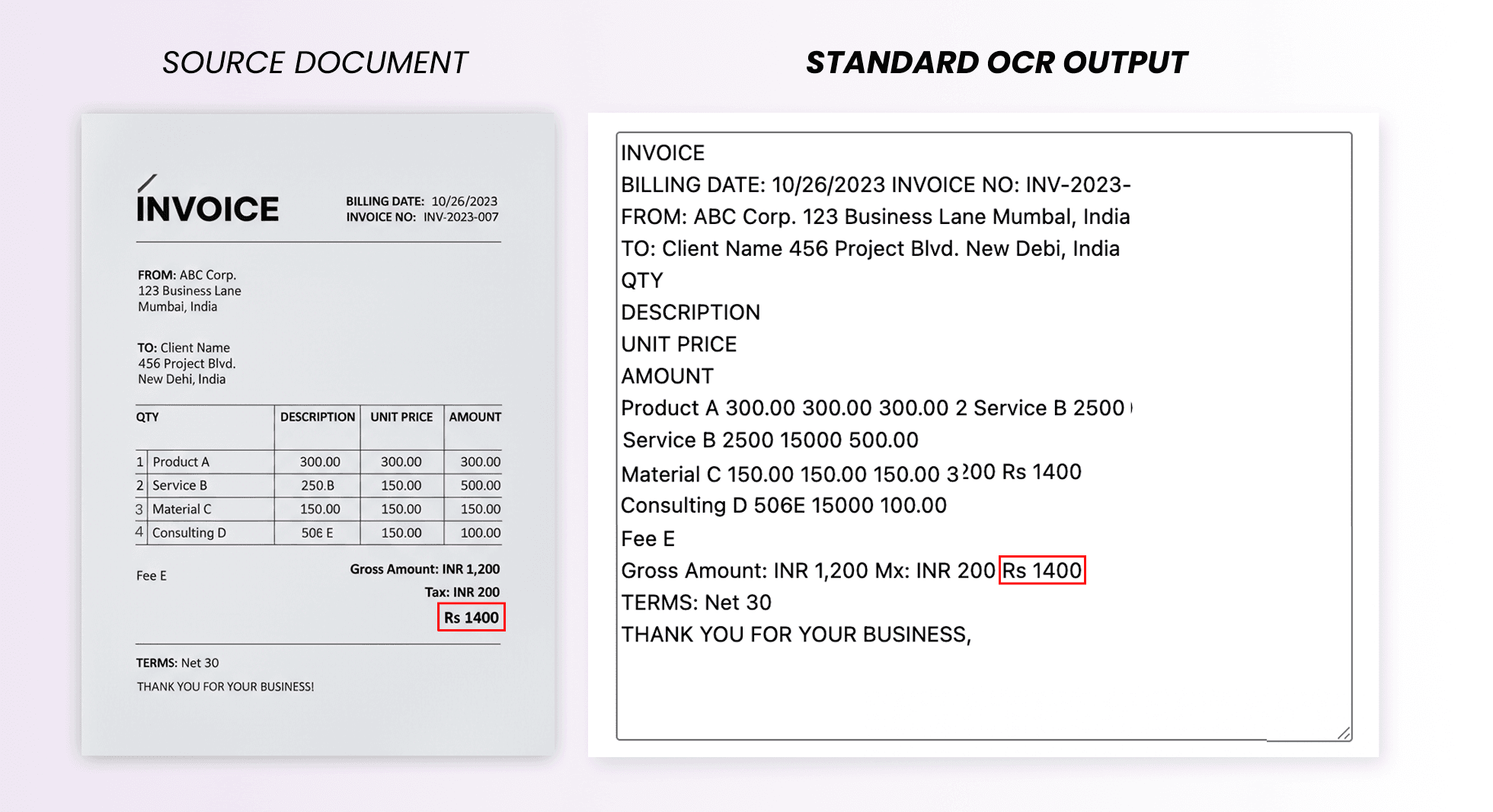
Let’s take a simple example:

An invoice lists “Gross Amount: INR 1,200” and “Tax: INR 200.”, and "Rs 1400" written but not labelled. An OCR will read the INR 1400 as just a value but the system can’t reason about it's meaning. A human, on the other hand, would instantly see that value is actually the Net/Total Amount.
Standard OCR Output.png

That’s the gap DocWise was built to close, bringing human-like understanding to document intelligence.

  1. Humans don’t just extract. They interpret.

  2. DocWise does the same. It reads, reasons, and reconciles information before deciding what it means.

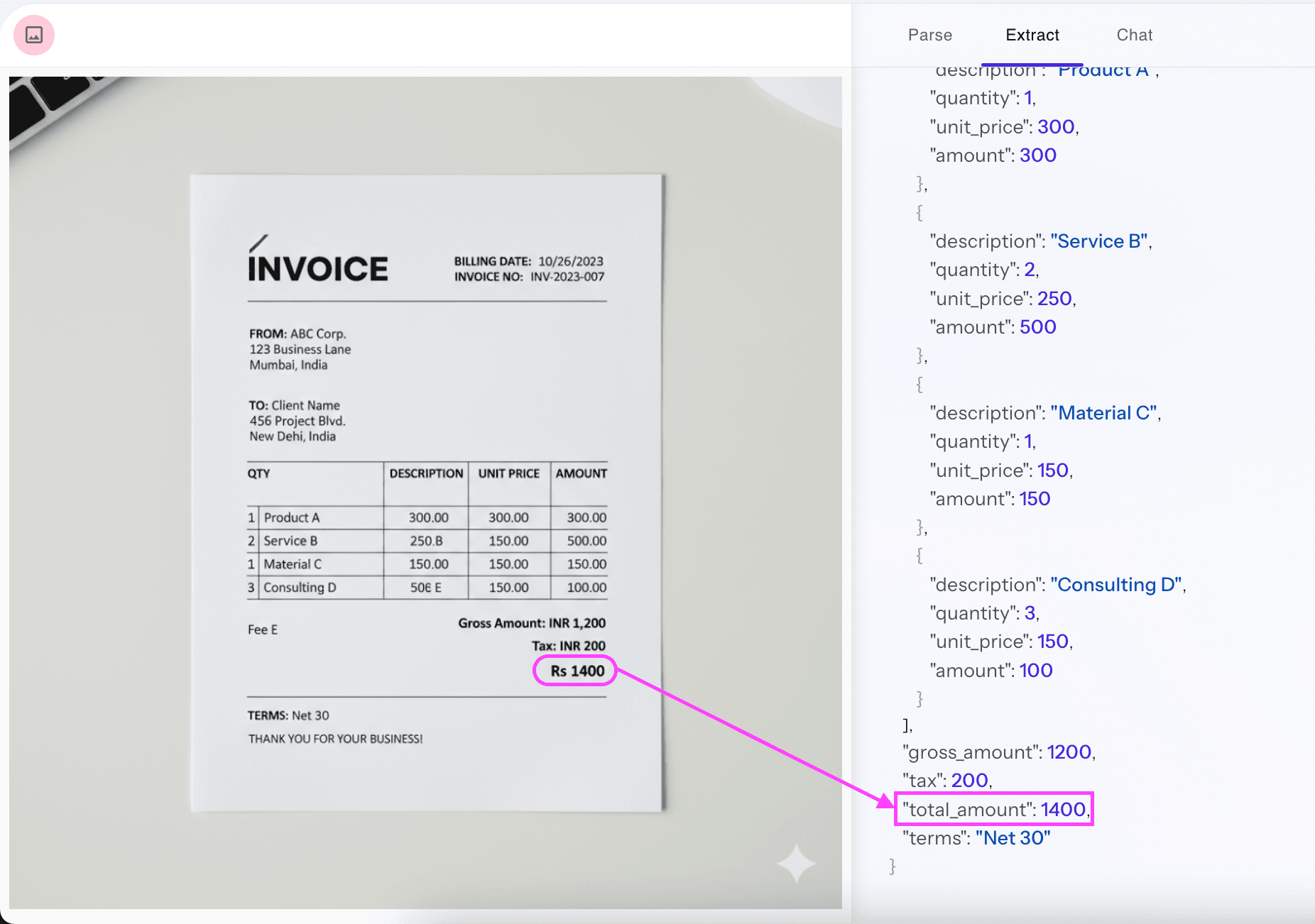
When DocWise processes the same invoice, it delivers a more structured, decision-ready output. It intelligently understands the document’s context, recognizing that the INR 1,400 isn’t just any number, but the total amount. of the invoice.
Screenshot 2025-10-27 at 8.36.39 AM.png

DocWise: A Context-Aware Approach to Documents

Instead of treating a document as a flat image, DocWise sees it as a structured narrative, one where every block, line, and label plays a role in the story.

Behind the scenes, it operates as a multi-agent system, where specialised components collaborate to read and interpret information intelligently.

Key Agents in Play

  1. Parsing Agent: Digitises text and structure from documents with precision using OCR and Visual LLM

  2. Extraction Agent: Interprets the parsed content using LLM to understand meaning, context, and relationships

  3. Reasoning Agent: Analyses content to cross-validate extracted information against intent and possible conditions

  4. Output/Delivery Agent: Delivers structured, decision-ready data for downstream automation and decision-making

Each agent focuses on one part of the reasoning process. Together, they recreate how humans process documents, contextually, and with feedback loops. The result is not extraction; it’s understanding.

How Agentic AI Works.png

How DocWise Understands Context

At its core, DocWise builds a structured understanding of every document and unlike an OCR it isn't just a flat sequence of text like an OCR.

It leverages advanced vision intelligence that enables interpretition of the content in the way humans do with visual grounding. By recognizing spatial cues, headings, tables, and positioning, DocWise links textual elements to their visual context, ensuring that meaning is preserved even in complex, multi-column layouts and nested tables.

Here’s how it interprets and reasons about content:

  1. Field Grouping & Relationships
    Groups related fields and interprets their relationships based on position and labels.

  2. Layout-Aware Hierarchy Mapping
    Understands complex layouts and hierarchy from headings, sub-sections to body texts, for accurate data mapping.

  3. Cross-Validation of Ambiguities
    Resolves ambiguous entries and cross-validates information using surrounding context to ensure accurate understanding.

  4. Predictive Handling of Missing Letters
    Fills in missing or unclear text using predictive intelligence.

  5. Annotations, Remarks, Notes
    Captures handwritten or printed notes, annotations, and remarks to maintain full document context.

This combination lets DocWise infer meaning the way humans do, by understanding relationships, layout, and context, not templates.

Showing Results2.png

From Understanding to Usable Data

After reasoning, DocWise translates understanding into usable decision-ready formats that can feed both human and machine workflows.

  1. JSON Output: To be used for downstream systems like CRMs, verification APIs, or automation flows.

  2. Markdown Output: For human review and reasoning traceability within automation pipelines.

Developers can directly integrate DocWise outputs with RPA tools, analytics dashboards, or database syncs.

Every document processed becomes structured, validated, and ready for decision-making, without needing predefined templates. Think of it as going from raw text to decision-ready data.

Outputs Markdown + JSON.png

Why Context Matters

The real world doesn’t run on perfectly formatted PDFs. It runs on messy scans, mobile captures, and layout drift. Context-aware extraction is what bridges that chaos to structured intelligence.

It matters because:

  • It reduces false positives that come from positional assumptions

  • It enables systems to reason about what’s missing, not just what’s visible.

  • It makes document data interoperable — understandable by both humans and machines.

Context turns data into meaning. Meaning turns documents into knowledge. That’s why Kriyam DocWise is designed around understanding first, extraction second.

Looking Ahead

DocWise today processes documents the way an analyst would, by reading, connecting, and verifying before concluding. Each document teaches the system something new. And with every iteration, DocWise gets a little more *wise.*But this is just the beginning.

The future vision is a specialized agentic AI platform that can enable enterprise to make documents workflows truly autonomously, reasoning across document sets, comparing one form to another, catching anomalies, and building richer business context over time.

Write to us at hello@kriyam.ai if you would like to know more about it.

About the author

Suvajit Sengupta

Suvajit Sengupta

Co-founder & CTO

Suvajit Sengupta | Co-founder & CTO

A passionate technologist who thrives at the intersection of customer needs and innovation. With a track record of building adaptive product teams, he share insights on solving real-world problems with AI and scalable tech solutions.

Interests: AI products, Team Leadership, Data Strategy

Content Overview

The Problem with Traditional Document Processing
DocWise: A Context-Aware Approach to Documents
How DocWise Understands Context
From Understanding to Usable Data
Why Context Matters
Looking Ahead

Complex Documents Breaking Your OCR?

Extract tricky layouts with more precision, context and confidence.

TRY DOCWISE

Share

FEATURED

thumbnail

Automation

Real-Time Case Management: A Game Changer in BFSI Operations

Revolutionizing Efficiency and Precision in Banking and Financial Operations with Real-Time Case Management

Suvajit Sengupta

Suvajit Sengupta

14th December, 2023

Solutions

Solutions

Company

Resources

© All rights reserved | Geogo Techsolution 2025

Logo

An Intelligent Trust Platform for secure, transparent, autonomous BFSI operations. Powered by Agentic AI.

Talk to an Expert

© All rights reserved | Geogo Techsolution 2025