How Investigative Practices in Insurance have Changed after the AI Revolution?
Kriyam.ai Content Team | 30th March, 2025
5 min reads
Kriyam.ai Content Team | 30th March, 2025 | 5 min reads
Fraud is one of the most significant challenges within the insurance industry, resulting in loss of billions of rupees each year in India and increasing premiums for honest buyers. Prior to usage of AI, inquiries were reactive, labor-intensive, and manual. Fraud detection depended on human judgments, paper files, and drawn-out verification exercises, making it simple for fraudulent parties to capitalize on inefficiencies within the system.
Following AI, fraud detection turned proactive and data-driven. AI-based systems examine huge datasets in real time and identify suspicious claims immediately. Automatic identity verification, document authentication, and predictive analysis minimize errors, accelerate investigations, and improve accuracy. As fraud continues to develop, AI-driven solutions are now a must for insurers to be ahead of the game and keep the system fair and efficient.
Challenges in Insurance Fraud Investigations
Insurance companies in India are challenged by the poor efficiency of the whole investigative procedures. But the new schemes of fraud are becoming so sophisticated and complex that they are getting ahead of the fraud control units, which themselves still use outmoded manual practices and legacy systems. Their practices fail to ensure timely responses and decrease overall effectiveness. Some of the leading causes of increased difficulty doing fraud investigation include:
Heavy Reliance on Manual Processes: The laborious process of documenting and paperwork used in investigations usually slows down the whole process. In fact, sharing the data based on spreadsheets or messaging platforms allows for various errors and complications in the workflow.
Limited Transparency and Tracking: Generally, insurers don't have tracking and visibility in the investigation in real time; therefore, in between gaps of the investigations, frauds could be hidden. This lack of oversight enables fraudulent activities to easily slip past the system.
Complexities in Vendor Collaboration: Poor channels of communication with external surveyors and investigators lead to data collection efforts not being aligned. This, unfortunately, could enhance the turnaround time by a great amount.
Data Consolidation Difficulties: Usually, the case history details are scattered all across different systems, which do not communicate with each other very well. This leads to a siloed approach, and thus it becomes very difficult to track and monitor the repeated fraudulent behaviors.
Lack of Data Privacy: The absence of data privacy exposes sensitive data of policyholders and investigations to being known by unauthorized persons through current investigations, thus raising fears of their possible misuse, legal penalties, and loss of customer trust. To add insult to injury, these very limitations render investigation processes inefficient and prone to error.
The gaps present in the investigation processes delay the investigations and provide opportunities for possible fraudsters to take advantage of the system vulnerabilities. Therefore, there is a need for the industry to adopt smarter and streamlined processes of investigations to tackle these issues.
Read Also: Fraud Risk Mitigation Strategies To Protect Your Insurance Business
The AI Advantage: How AI is Revolutionizing Insurance Fraud Investigations?
Insurance fraud investigations have historically been time-consuming, based on slow, labor-intensive, and error-prone manual processes. With the use of AI, investigations are now more accurate, data-driven, and highly automated. Below, we contrast each phase of an insurance investigation, illustrating how AI has transformed the process with real-world examples.
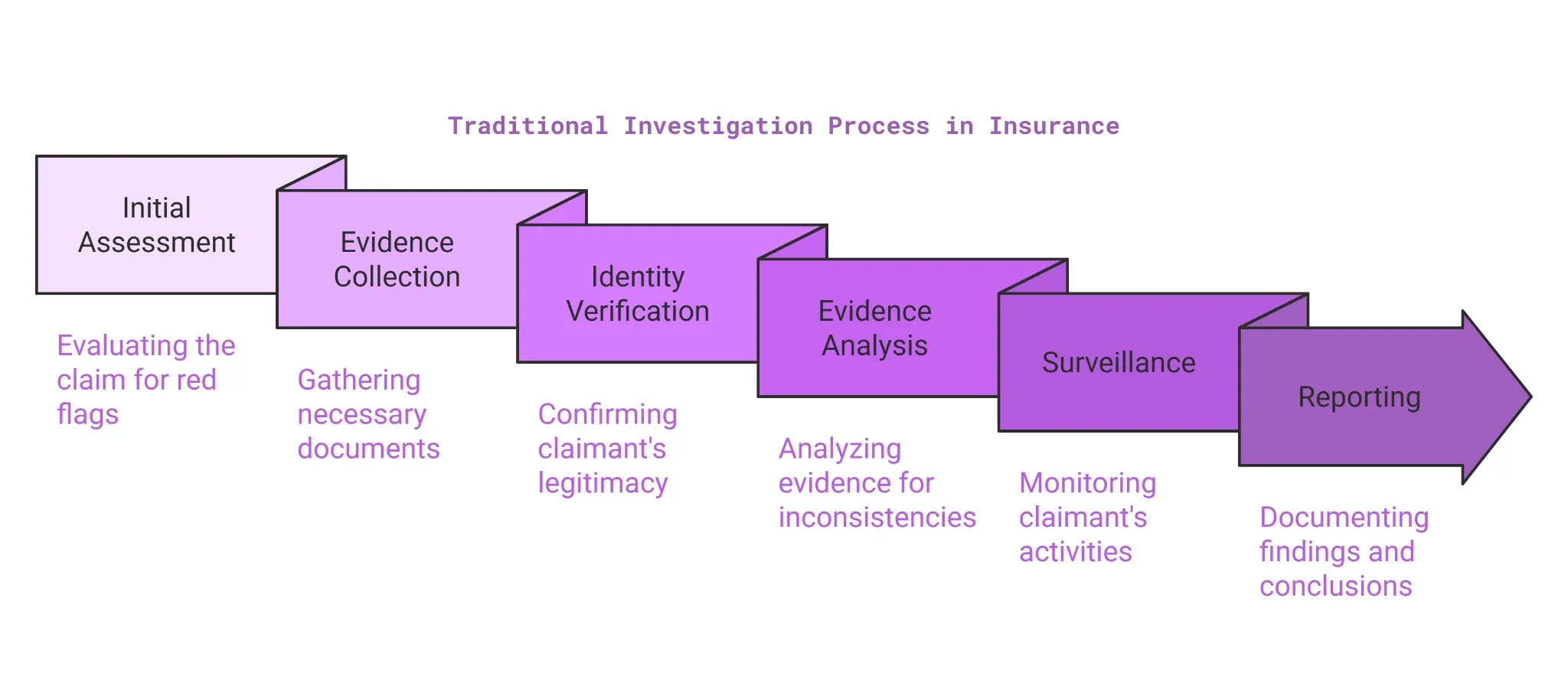
The following components form part of traditional investigative practices in insurance:
Continue reading this article
You're just one step away. Complete the quick form below to
unlock this article — and explore the rest of our blogs.
About the author
|
Content Overview
Share
FEATURED



Insurance
5 Ways Agentic AI is Transforming Insurance Industry
This blog explores how pioneering insurers are leveraging Agentic AI to solve critical challenges—from eliminating claims backlogs to hyper-personalizing policies—while addressing ethical and operational hurdles.

Sreyan M Chowdhury
30th March, 2025